


When swallowing becomes difficult, even a favourite meal can feel exhausting. You may eat slowly, avoid certain textures or worry that food will get stuck. Understanding the cause is the first step towards choosing treatment that fits your needs.
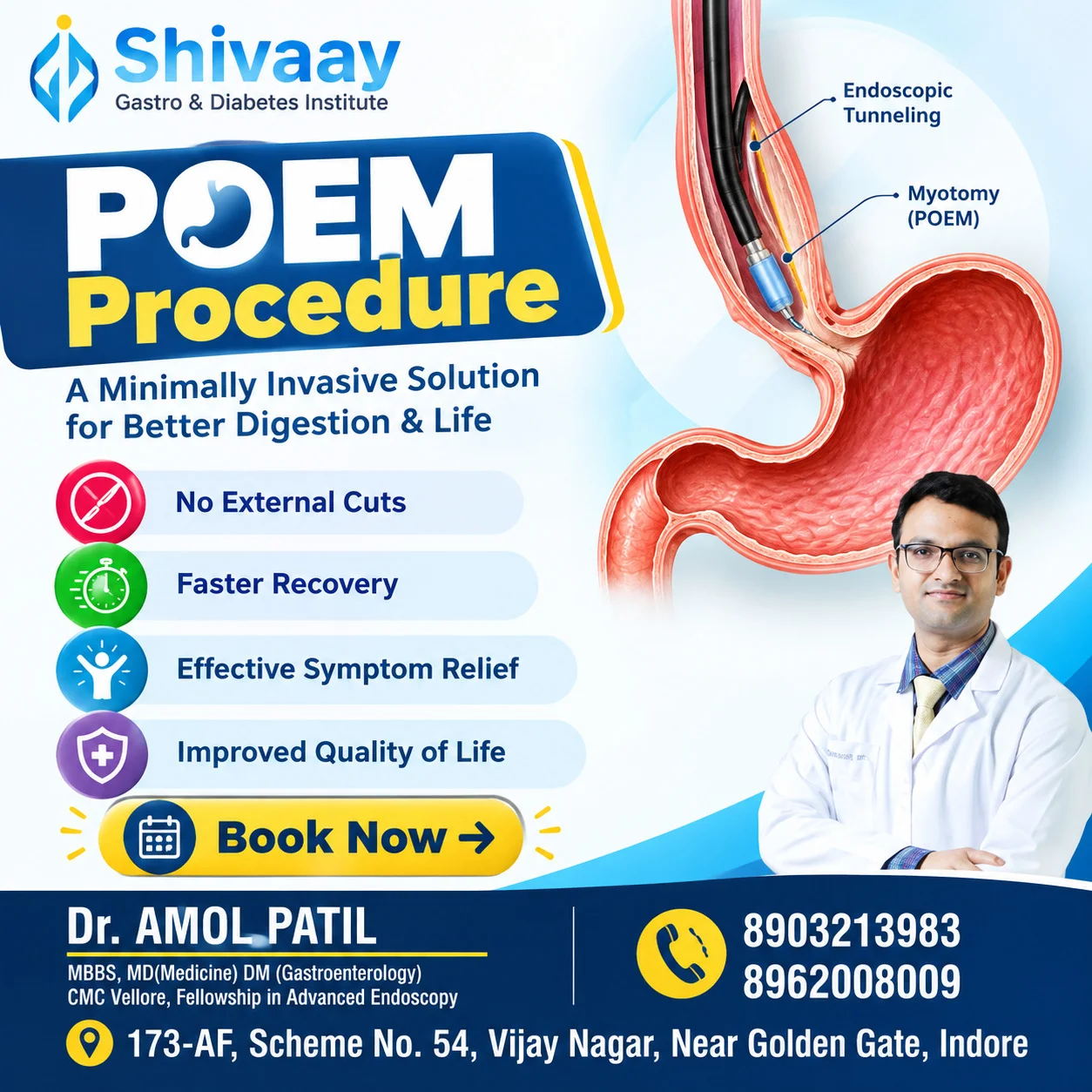
Peroral endoscopic myotomy (POEM) is a minimally invasive procedure used mainly to treat achalasia, a condition that affects how the food pipe moves food into the stomach. A specialist passes an endoscope through the mouth and cuts selected tight muscle fibres to make swallowing easier. There are no external skin incisions, although the procedure involves an internal incision.
For people exploring achalasia treatment in Indore, Shivaay Gastro & Diabetes Institute is a local point of contact for a consultation with Dr. Amol Patil. This guide explains the assessment, treatment choices and follow-up questions worth discussing.
The oesophagus, commonly called the food pipe, normally moves food downward through coordinated muscle contractions. At its lower end, a muscular valve opens to let food enter the stomach.
In achalasia, those movements are impaired, and the valve does not relax properly. Food and liquids can therefore collect above the stomach.
Common symptoms include:
· Difficulty swallowing solids, liquids or both.
· Food returning to the mouth after eating.
· Chest discomfort associated with swallowing.
· Night-time coughing or choking.
· Unintentional weight loss as eating becomes harder.
These symptoms can overlap with other conditions. An examination helps distinguish a movement disorder from narrowing, inflammation or another cause.
Choosing a procedure starts with establishing the diagnosis. Your specialist may recommend a combination of investigations:
· Upper GI endoscopy: A camera examines the food pipe and stomach, helping identify narrowing, abnormal tissue or other explanations for symptoms.
· High-resolution oesophageal manometry: Pressure measurements show how the muscles contract and how the lower valve behaves during swallowing.
· Barium swallow: X-ray images taken after swallowing contrast liquid help assess the shape of the food pipe and its emptying.
Manometry and a barium study answer different questions; one measures muscle activity, while the other provides imaging information.
Bring earlier reports to your appointment. A clear test history can help the doctor decide which investigations remain necessary.
The treatment is performed under general anaesthesia. An endoscope with a camera allows the specialist to work inside the food pipe while viewing the area on a monitor.
The main stages are:
1. Creating a small opening in the inner lining of the oesophagus.
2. Forming a tunnel between the lining and the underlying muscle.
3. Cutting selected muscle fibres, including those at the tight lower valve.
4. Closing the entry opening with endoscopic clips.
The aim is to reduce resistance so food can pass into the stomach more easily. The treatment plan determines how far the muscle division extends.
Suitability depends on the confirmed diagnosis, achalasia subtype, general health and previous treatment. POEM can be particularly useful for type III, or spastic, achalasia because it allows a longer muscle division when needed.
Other options include pneumatic dilation, which stretches the lower valve with a balloon, and laparoscopic Heller myotomy, which divides the muscle through small abdominal incisions. Heller myotomy may be combined with an anti-reflux procedure. Botulinum toxin injections are sometimes considered for patients who cannot undergo more definitive treatment.
Ask your doctor how each option compares for your condition, including symptom improvement, reflux risk and the possibility of further treatment.
For suitable patients, the main attraction is treating the tight muscle through the mouth, without external wounds. Improved swallowing may make meals more comfortable and support better daily functioning.
However, the procedure does not eliminate the underlying lifelong condition. Treatment focuses on easing the passage of food, and follow-up remains important even when symptoms improve.
A meaningful discussion should focus on your goals: eating a wider range of foods, maintaining weight or reducing regurgitation. Expected improvement and recovery vary between individuals.
Before treatment, share your medication list, allergies and relevant medical history. Mention blood thinners, diabetes medicines and previous reactions to anaesthesia so the team can provide appropriate instructions. Do not change prescribed medicines independently.
Preparation commonly involves a temporary liquid diet and a fasting period. Follow the treating team’s written schedule, including exactly when to stop eating and drinking.
Arrange practical support for discharge and early recovery. Confirm whether someone should accompany you, how long observation is expected to last and whom to contact if concerns arise at home.
Write down questions beforehand; it is easier to make decisions when both the medical plan and practical arrangements are clear.
Observation after treatment allows the team to assess your recovery and decide when it is appropriate to restart drinking and eating. Some patients need an overnight stay or longer monitoring.
Food is generally reintroduced in stages, beginning with liquids and progressing according to the prescribed plan. Ask for specific guidance before returning to familiar foods such as dal, khichdi, roti or rice. Returning to work also depends on your recovery and whether your job involves lifting or physical exertion.
Seek prompt medical attention for severe or worsening chest pain, fever, vomiting blood, black stools or feeling faint after the procedure.
Acid reflux after POEM is an important follow-up issue. Loosening the lower valve can allow stomach contents to flow back into the oesophagus. Other potential complications include bleeding and injury to the lining. Your specialist should explain the risks relevant to your health.
Reflux-related changes may occur even without obvious heartburn. Follow-up may therefore include endoscopy or other testing, depending on the clinician’s assessment.
Take prescribed acid-suppressing treatment as directed and attend scheduled reviews. Easier swallowing is encouraging, but ongoing care also checks how the food pipe is healing and functioning.
When looking for a gastroenterologist in Indore, consider whether the consultation includes a clear explanation of your diagnosis, available treatments and follow-up needs.
Dr. Amol Patil’s professional profile lists a DM in Gastroenterology from Christian Medical College, Vellore, and training in advanced endoscopy.
For patients visiting Vijay Nagar, Indore, the consultation address is 173-AF, Scheme No. 54, near Golden Gate. Confirm appointment timing before travelling.
A useful discussion can cover:
· Which findings support your diagnosis.
· Why a particular treatment is being considered.
· Where testing, treatment and observation will take place.
· What the estimated charges include.
· How follow-up will be arranged after discharge.
Patients travelling from elsewhere in Madhya Pradesh can also ask about coordinating appointments to make the visit easier to plan.
No. Routine endoscopy mainly examines the digestive tract and may include sampling tissue. POEM is a therapeutic procedure that uses an endoscope to access and divide selected muscles beneath the inner lining.
Yes, symptoms can recur. Report renewed swallowing difficulty or regurgitation rather than assuming the original problem has returned unchanged. Reassessment helps identify the cause and guide the next step.
Previous treatment does not automatically rule it out. Some patients undergo POEM after dilation, botulinum toxin injections or Heller myotomy, but suitability requires an individual review.
The estimate can depend on investigations, anaesthesia, procedure charges, hospital observation and medicines. Request an itemised estimate and ask whether follow-up visits are included. Confirm insurance eligibility and any pre-authorisation requirements directly.
Persistent swallowing problems deserve a clear diagnosis and a treatment discussion tailored to you. Contact Shivaay Gastro & Diabetes Institute to book a consultation with Dr. Amol Patil and discuss whether the POEM procedure in Indore is appropriate for your condition.
Contact Us Today to Book Your Consultation!
| Tags: | #POEM Procedure in Indore |


